




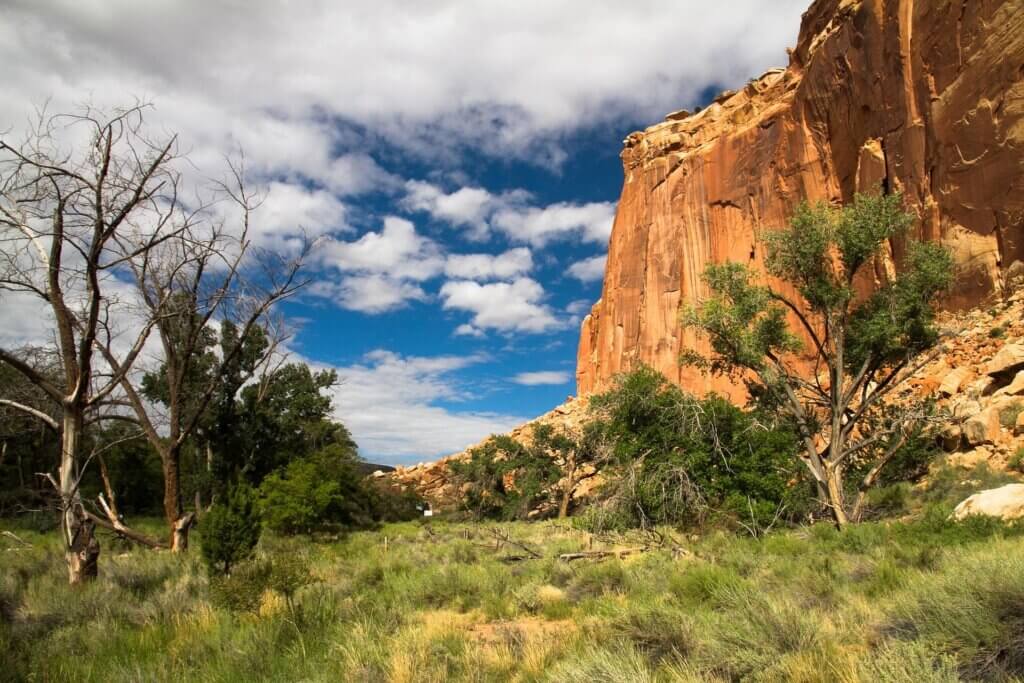
Capitol Reef National Park is in south-central Utah, United States in Wayne County near the small town of Torrey. It’s set in the dramatic red rock landscape of the Colorado Plateau at the heart of Utah’s famous national parks region, often sitting between Arches National Park and Bryce Canyon National Park if you’re doing a parks road trip.
What makes Capitol Reef truly distinctive is the Waterpocket Fold, a nearly 100-mile long geologic wrinkle or “monocline” in the Earth’s crust. Over millions of years this fold was lifted and eroded to reveal layers of sandstone, shale, and fossil-bearing rocks, creating cliffs, domes, arches, canyons, and hoodoos you can explore. The name Capitol Reef comes from early settlers: the white Navajo sandstone domes reminded them of the U.S. Capitol building, and the rugged cliffs seemed like a “reef” blocking travel.
A BIT OF HISTORY
Ancient Peoples
Long before Europeans arrived, ancient groups like Archaic foragers and the Fremont Culture lived, farmed, and traveled in the region. You can still see petroglyphs and remnants of these early people’s lives carved into the canyon walls.
Pioneer Settlement
In the late 1800s, Mormon settlers established farms and orchards along the fertile Fremont River. Their community, called Fruita, planted fruit trees — apples, peaches, pears, cherries — that surprisingly still grow today and are part of the park’s living history.
National Park Status
The region became a national monument in 1937 and finally achieved full national park designation in 1971, preserving its scenery and stories for visitors.


WHY PEOPLE LOVE VISITING
People enjoy Capitol Reef for its blend of geology, history, solitude, and unexpected greenery. It’s less crowded than some other Utah parks, meaning you often feel like you’re discovering it rather than just “seeing it.” The contrast of desert sandstone and lush orchards, deep canyons you can hike, and wildlife — from birds to bighorn sheep — make it a rich experience for nature lovers and adventure seekers alike.
TOP THINGS TO DO
Here are the highlights that visitors typically enjoy:


Scenic Drive
The Scenic Drive winds through the heart of the park with stops for rock formations, overlooks, and trailheads. It’s one of the easiest ways to sample a lot in a short time.
Historic Fruita and Orchards
Explore the orchards planted by settlers. During summer and fall, signs indicate when fruit is ripe and visitors can pick and eat apples, cherries, peaches, etc. A bit of simple orchard picking surrounded by desert is a totally unique experience.
Hiking Trails


There are trails for family members and seasoned hikers alike.
Hickman Natural Bridge Trail leads to a spectacular natural bridge.
Cassidy Arch Trail offers stunning views and a dramatic arch named after outlaw Butch Cassidy.
Sulphur Creek and Grand Wash are great for deeper canyon wandering.
Petroglyph Panels
These ancient rock carvings give a window into life here over a thousand years ago.
Gifford Homestead
Not in every guidebook, but widely loved, the historic Gifford Homestead sells pies and treats made with orchard fruit — a real locals-and-visitors favorite.
PARKING AND AMENITIES
Visitor Center: Your first stop. Friendly rangers can provide maps, trail information, current conditions, and tips.
Parking: There are parking areas at main trailheads and scenic spots. Arrive early in busy months because lots can fill.
Campground: Fruita Campground is the main developed site where you can camp among trees near the river.
No Lodges Inside the Park: While there’s no full-service lodging inside the park, the nearby town of Torrey offers hotels, restaurants, and services.
GENERAL RULES AND PET POLICIES
Respect all trail closures and posted signs. Stay on trails.
Permits are required for overnight backcountry camping, canyoneering, and climbing.
Pets must be on leash (no longer than six feet) and are allowed in developed areas, campgrounds, picnic spots, roads, and orchards. They are not permitted on most hiking trails or in backcountry areas or buildings.
Leave no trace: pack out what you pack in, and don’t disturb historic or archaeological sites.
SEASONS AND BEST TIMES TO VISIT
Spring and Fall (March–June and September–October) are generally ideal — mild temperatures and trails that aren’t too hot or cold.
Summer can be extremely hot and flash floods are more common with monsoonal storms.
Winter offers solitude but can be cold and icy in spots.
RISKS AND SAFETY PRECAUTIONS
The park doesn’t present unusual dangers, but the environment demands respect:
Heat & Dehydration: Carry plenty of water — plan on a gallon per person per day.
Flash Floods: Canyons can flood rapidly after storms, even far upstream. Check weather before entering narrow washes.
Slips/Falls: Trails can be slick and cliffs are steep, so stay on marked paths and watch footing.
Wildlife: Don’t feed or approach wildlife.
FESTIVALS, EVENTS, AND COMMUNITY
Capitol Reef doesn’t have large concerts or big competitions within the park itself, but local events near Torrey and in nearby communities can include harvest festivals in early fall, geology talks in summer, and county fairs that give a local flavor to your visit.
LEGENDS, MYTHS, AND LESSER-KNOWN STORIES
Butch Cassidy Connection: The park has a trail named for outlaw Butch Cassidy, who reportedly hid in nearby canyons.
Some Native American stories refer to parts of the region as sacred, with place names like the “Sleeping Rainbow.”
The juxtaposition of fruit orchards in an arid desert is almost mythic — a green oasis that defies expectations.
THE GOOD, THE BAD, AND THE REALITY
Good:
Vast, varied scenery without the crowds of bigger parks.
Geological diversity — you see millions of years of Earth’s history laid bare.
Historic orchards and pioneer sites give a cultural dimension.
Bad:
Limited amenities inside the park itself — basic campgrounds and picnic areas, but no full lodges or restaurants.
In summer heat and storm seasons, conditions can be harsh.
Reality:
Capitol Reef isn’t the flashiest park, but many visitors end up loving it precisely because its quieter, more contemplative — a place where geology, history, and solitude come together in a way that feels very personal rather than commercial.
HERE ARE RELIABLE OFFICIAL AND DETAILED RESOURCES WHERE YOU CAN LEARN MORE ABOUT EVERYTHING WE TALKED ABOUT REGARDING CAPITOL REEF NATIONAL PARK — FROM PLANNING YOUR TRIP TO MAPS, HISTORY, RULES, HIKING, CAMPING, SAFETY, PET POLICIES, AND SPECIAL FEATURES OF THE PARK:
Official Park Sources
These are the most accurate, up-to-date links directly from the National Park Service and Utah travel authorities:
Main Park Website
- Capitol Reef National Park (National Park Service) – official homepage with general info on geology, wildlife, history, ranger programs, and more:
https://www.nps.gov/care/
Planning Your Visit
- Plan Your Visit (NPS) – hours, fees, maps, weather, camping info, scenic drives, permits, accessibility, things to know before you go:
https://www.nps.gov/care/planyourvisit/index.htm
Hiking Information
- Hiking (NPS) – trail descriptions, maps, pet safety, Leave No Trace tips:
https://www.nps.gov/care/planyourvisit/hiking.htm
Orchards & Historic Fruita
- Orchards — National Park Service – the history of the orchards and how picking fruit works:
https://www.nps.gov/care/learn/historyculture/orchards.htm - Visit Utah – Capitol Reef Orchards – seasonal fruit schedule and rules for u-pick fruit:
https://www.visitutah.com/places-to-go/parks-outdoors/capitol-reef/must-see-capitol-reef/fruita-and-u-pick-orchards
Rules, Regulations & Pets
- Regulations (NPS) – details on what’s allowed (pets, drones, hunting, roads) and other park rules:
https://www.nps.gov/care/regulations.htm
Things To Do
- Things To Do (NPS) – ideas for hikes, scenic drives, orchards, picnic areas, suggested itineraries:
https://www.nps.gov/care/planyourvisit/things2do.htm
Helpful Travel Guides & Overviews
These sites aren’t official, but they offer practical descriptions, tips, and ideas on what to do in the park:
- Capitol Reef travel overview on VisitNationalPark.com (general park info plus suggested itinerary ideas):
https://www.visitnationalpark.com/park/capitol-reef - Capitol Reef Tours & Visitor Guide on TourParks.com – describes visitor center, Scenic Drive, and major attractions:
https://www.tourparks.com/parks/capitol-reef/
Additional Context & Tips
If you’d like firsthand experience and safety tips from other travelers:
- Search “Capitol Reef NP visitor tips” or similar on YouTube for video guides and mistakes to avoid (e.g., 9 Mistakes to Avoid When Visiting Capitol Reef National Park).